I'm Currently Playing...

Blur [Xbox 360]
Tiger Woods PGA Tour 11 [PS3]

Showing posts with label PS3. Show all posts

Wednesday, 14 July 2010

Review- Toy Story 3: The Videogame [PS3]

Publisher: Disney Interactive Studios
Developer: Avalanche Software
Released: 16th July 2010
Other Formats: Xbox 360, Wii, PC

If you hadn't already been made aware, Pixar's crowning glory returns to silver screens this summer in Toy Story 3 (out in the UK on the 19th July, if you're interested), and with it of course, is the tie-in videogame- this time from developer Avalanche Software and Disney Interactive Studios. Of course, movie tie-ins are often, and unmistakeably, poor. However, it seems obvious how far Avalanche have come in delivering sufficient thought towards the game of the same name, with a rich and colourful visual style that sticks true to the franchise's heritage, whilst the platforming and puzzle mechanics at the heart of the game is deft in applying a good deal of challenge for all ages and being entertaining in equal measure.

Whether you choose to forgo through the story missions that interweave between the narrative of the aforementioned CG offering, (and thus, presenting many of the new cast of characters), or jump on Bullseye for a ride around the open-world toy box, the game very rarely fails to delight. The “ToyBox Mode” open world offering seeing Woody become sheriff of the Western-inspired toy-town, western strings plucking along to the rhythm of game play, as you complete missions and mini-games as you see fit for any of Toy Story's excellent characters. From clearing mine shafts for Stinky Pete, to sprucing up the town for Mayor Hamm and capturing criminals to throw into the town jail, the toy box represents a good deal of game play in only a tiny proportion of the overall package on offer. The area is large and intricately designed enough for the more mundane 'fetch' tasks to remain relevant and adequately challenging, whilst also familiar enough to alleviate unnecessary meanderings. Extra toys, whether vehicles or perfunctory buildings, can be bought from Al's Toy Barn for coins that are awarded for completing missions (each with a fantastic TV style ad to match), to add to the town. The vast weight of the game comes from the story missions that perhaps best demonstrate the game's effective and enjoyable platforming mechanics.

With many missions underwhelming and defunct of ideas in terms of contextualising such instances into the overarching plot, the lay-out of each are surprisingly well thought out for the game to flourish in delivering a superb single player, and even better co-op experience. Revolving mostly around 3D platforming, the controls feel sensitive and in-tune with the very best of platformers, even though the level design could perhaps be improved upon for the game to stand alone on its own terms- many of the levels being a split between 'find the item'/mini-game/platformer. The platform sections work best, infused with puzzles that handle the ability to switch characters (between Woody, Buzz or Jessie, using L1) effectively. Each of their own unique abilities (such as Jessie's ability to land on smaller platforms or Buzz's laser targeting), meaning many of the puzzles that break up the platforming sections are sufficiently challenging and ensuring the game's ability to co-op with other players exceptionally rewarding, with players working together towards the end of the level. Story missions such as 'Junkyard' expel all that is great about the game, with each character's abilities intertwined and interspersed between each other towards a conglomerate resolution of stopping Rex, Slinky and Hamm from entering the mouth of the junk machine- where Jessie landing on valves allows Woody to swing to the next mechanical button, thus allowing Buzz to knock down a piece of junk to Jessie for further progression, a prime example of the developer's quality. It's instances such as these in which the game really gives the shows the best qualities on offer, alleviating it above other movie tie-ins that so often, fail to excite.

Where it falters the most is within its fetch quests, where areas are often idly paced up and down to find something that has been hinted toward- shallow ideas denting the well crafted whole. Some of the missions are also drab and dull, especially where Buzz is involved, with the over-the-shoulder lock-on shooting mechanic poor, making the endless destruction of the waves of enemies forced at him a repetitive slog to the invisible timed marker, with the rich interpretation of Toy Story 2's opening scenes a particularly resonant and stand out moment of the game, but poorly realised due to the underwhelming combat that has been given little thought. It makes me question what could have been achieved had the developer been given enough time to balance and refine the part's of the game which have obviously been rushed towards its release date, where the fetch quests make sense to bulk out the game. Avalanche Software have demonstrated assurance and quality in many instances, with some excellent ideas thrown in.

Otherwise infused with enough replicated Pixar charm and sentimentalities from the films, the game stands up very well visually, retaining playful and insightful characteristics from each of its characters and thus allowing them to each stand out very well within the game, whilst delivering refreshing and delightful colourful sets and game locations. From the dusty plains of the toy box contrasting to the bright neon-lit swathes in space, the beloved Toy Story 3 franchise is expertly brought to screen, imbuing the essence of the game with enough uniquely designed settings to keep the game pacey and interesting for the whole of its stay. The sparsely used but surprisingly adept cut scenes also doing well to add enough humour for the audience, introducing us to new characters (Peas in a Pod a particular highlight), while stitching together a loose plot.

Hugely enjoyable for the most part, Toy Story 3 can be considered amongst the best of film to videogame tie-ins for sure. Demonstrating enough charm and exceptional visuals for fans of the series, with the puzzle and platforming sections of the game doing their very best in giving gamers reason to take notice. It's no classic platformer, but neither can it be considered cheap and defunct of ideas, this movie tie-in is worthy of the Toy Story name and can be appreciated singularly, aside from the film.


*This review can also be found on www.dpadmagazine.com

Wednesday, 7 July 2010

Review- Split/Second: Velocity [PS3]

Publisher: Disney Interactive Studios
Developer: Black Rock Studio
Released: 21st May 2010
Other Formats: Xbox 360, PC, iPhone

Like a Michael Bay production with added vehicular destruction, or a pyrotechnics wet dream, Split/Second:Velocity pulls no punches in following the crowd with simple arcade racing fare. Instead, the race for the chequered (yet slightly singed) flag will come from negotiating your way around the fully destructible tracks on offer, where towers crumble to the floor in an explosive heap of concrete, where aircraft land precariously over the race track and whole raceways fall under the weight of revving engines. This is something barely witnessed before. Sure, games have messed with destruction in the racing genre (Motorstorm: Pacific Rift comes to mind specifically), but rarely has a game's core concept been driven around such a gimmick.

And don't let the word 'gimmick' put you off either, for Split/Second's reality TV show destruction package is as near you'll get for some time to a racer so action packed and utterly enjoyable as this. Similar in style to Criterion's excellent racer Burnout 3: Takedown but with added 'oomph', shall we say, SS's premise is made possible through each driver's use of the so-called “powerplay” action moves that enable triggered and pre-scripted explosions on-track to blast their way into the game's racing carnage with aplomb- a mixture of extraordinary graphical fidelity (some of the best explosions ever witnessed) to brilliant audio cues (a lull of silence before a huge eruption resounds from speakers)- in filling up the “powerplay meter”.

Split into three sections, the meter slowly fills through drifting, drafting and jumping and, depending on how much is filled, will also allow you to trigger one of two powerplay events. Whilst the first two sections allow for small explosions (I say small, I mean 'small' compared to others!) and the ability to open short cuts, the latter section can devastate opponents' plans for first in enormous and hugely impressive moments in which you'll (figuratively speaking, of course) literally have to pick your jaw up from the floor. Not only can such events crush opponent's into mere folds of scraping metal, the track can also progressively change depending on which event was triggered. One such example on the 'Airport' level sees a tower crashing down onto the previously untouched asphalt, only to open a huge expanse of open runway (in which the aforementioned jumbo jet will no doubt crash land onto your shiny, glittering body work that is showcased beautifully with Split/Second's gorgeous visuals- Black Rock also cleverly incorporating the HUD (containing the meter, position etc.) under the rear bumper of the car. Such design choices are minute and yet extremely beneficial where such elements would otherwise obscure the blinding thrills, something so simple but an idea which I'm sure other developers will likely use in following games.

Moving on to Velocity's arcade racing, and again, Black Rock have delivered in abundance. Vehicles are marked out in favour of drifting, speed, strength and acceleration levels, although of all vehicles that I managed to try out, all felt remarkably weighty and pleasant to drive. You'll no doubt find an ideal motor that suits your style of play and the embellished game mode, with speed sacrificed for stability (vital for powerful explosions and the 'Survival' mode- where a truck drops explosive barrels in front), stability sacrificed for speed (more useful for races and 'Devastator'- a take on time trial where explosive events trigger automatically). The latter mode being the most useful in seeing all that each track has to offer, with the excellent 'Airport' a stepping stone on the way to the tricky and awesome, fiery and hazardous charge of 'Airplane Graveyard' where no jet engine is stable. Progressing through the season mode within the game is expertly handled, in which points are awarded based on your finishing position, thus contributing to a 'episode' finale showdown with the fastest drivers to qualify for the superseding episode (a total of 12). In paying attention to the lull that can be a staple of the racing genre, Black Rock consistently vary game types throughout and keep things rolling at a fair old rate. No event is too long and neither are two ever the same, with a number of events; 'Race', 'Devastator', 'Survival', 'Air Strike' and 'Air Revenge' all contributing to the persistent, dependable, unabashed and unshakeable revolve of action sequences. And although others can complain that the game suffers after the initial exhilaration phase of seeing powerplays for the first time, I can conclude the exact opposite. Yes, the first time around a track is a delight, but in learning each track corner by corner, play by play, can the game only really come alive. It's where the game turns from gimmick into a true arcade racer, where skill is as important as tactics.

There seem to be only a few minor faults that resonant to me about the game. I can't help but be wary of first position- not only does Split/Second ultimately punish those in first with the inability to use powerplays at all (only short cuts can be activated), meaning action at the front of the pack is often the more dull, strange considering the 'racing' aspect of the game. I'd like to have seen some way in which opponent's can still be, maybe indirectly even, given a harder route to your rear bumper (rubber banding accounting for such instances), perhaps incorporating the excellent slow-mo replays to what is happening elsewhere as a result of your actions. Also particularly noticeable in multiplayer was the way in which first place, if not stopped early on, can ultimately win the race with opponent's almost helpless in pursuing since powerplays are limited to what the player can see and only those directly in front. I'd also have loved to see a similar mechanic to Criterion's Takedown in which opponent's can be pushed into obstacles and the like to result in a “wreck” (in addition to the destructive powerplays), which could have added another dynamic to the play and going on to improve the arcade feeling of the game as a whole.

Featuring two player split screen multiplayer, as well as rousing online play, a full career mode and quick play, Split/Second is a joy to play. In concentrating on the explosive set pieces, Black Rock have engorged us on an arcade racer that deserves its place alongside the greats of Burnout and Outrun. Guaranteeing enormous re playability and a whole load of throwaway fun, this is a racer worthy of your time.


Take a look at my preview of Split/Second here.

Sunday, 13 June 2010

Review- Alpha Protocol [PS3]

Publisher: Sega
Developer: Obsidian Entertainment
Released: 28th May 2010
Other Formats: Xbox 360, PC

Alpha Protocol is a strange release, for sure. Originally pushed back from an October 2009 release, you'd have thought that the developer, Obsidian Entertainment, would have devoted all their time to refining their game with the triple-A layer of polish that modern gamers now take for granted. As it is, I only have to question Obsidian's true level of intent in favouring the continuation of the Fallout license in this year's New Vegas rather than devoting all it's weight to make this spy espionage RPG anything but lacklustre.

In using the Unreal Engine 3, famed for its cover system- but let down in other departments- it's perhaps not surprising to see a poor graphical edge, low-res textures, texture pop-in and severe drops in frame rate when the going gets tough. Granted, other developers can give sufficient power to the engine (Epic, as creators no less, have excellent experience), but in perhaps devoting more time to other parts of the game, Obsidian seem to have forgotten that the HD crowd demand unquestionable graphical fidelity.

However, good games aren't made through great graphics and neither are bad graphics a decider of poor games. First off, I applaud Obsidian for trying something different in what can be a very staid RPG genre- the spy/ espionage take is certainly unique and interesting, and could have been a fertile ground to craft an almost Sam Fisher-like stealth actioner. As it is, however, playing as one of the most generic protagonists imaginable in Hollywood's most over-used of storyline- the government stitch-up, will give you little room for empathy with Obsidian's efforts. You play as Agent Michael Thorton whom is sent to Saudi Arabia to assassinate leader 'Shaheed'. It isn't giving too much away by informing you that a major plot twist occurs as Thorton is listed as a threat to his country, on a mission to track down those responsible for the cover-up. Extremely passable and throwaway, the poor dialogue and dull and wooden delivery do little to flesh out the character's at the centre of the game's story. Instead, the intended intent seems to amount to blasting from Intel message through to mission objectives, only so that the poor plot can be leaped through in the quickest way possible. Sadly very much passable with relation to its narrative thread, Alpha Protocol wishes to give me confidence in other aspects of its design...

The much vaunted cover system provides the ground at which AP's combat system plays out. Very much frustrating in its final form, the switch into cover is acceptable enough, although leaping from cover to cover (or over cover) isn't an option, which could have been a great design choice within its stealth-orientated game design where avoiding the gaze of onlookers is key. Elsewhere, weapons feel underpowered from the get go and are frustratingly underwhelming. This is slightly evened out however through the application of upgrades, additional perks and skills. The latter, skills, are a great addition and play a similar role to Mass Effect's 'powers'- giving a significant advantage when used, whether it be through slowing down time, or giving weapons an increased damage percentage. But whilst the skills go some way to alleviating the game's first problems, the guns on their own still feel severely lacklustre and poor. It makes me question the intent of Obsidian, whether they felt so inclined to push forward the stealth aspect of the game that they wanted the player to feel under-powered when forced into combat elswhere. Perhaps if the stealth mechanic wasn't utterly useless, then this might have been a good design choice. As it is, the cover mechanics and frustrating AI mean that stealth is very rarely a genuine option and thus, Alpha Protocol fails in its lofty ambition. It's almost as though the developer almost realised the poor implementation of their key mechanic, however, since the melee system is often the most powerful way to often dispatch your enemies- on more than one occasion I'd simply leg it to the nearest foe (in Thorton's hilarious 'slow-motion in fast-forward' running animation) and rapidly tapping 'Circle' to beat the clichéd enemy types to death- hardly the way Obsidian would have imagined it, surely. If you do decide to take the stealth option, you'll be tasked to avoid detection from camera's, monitoring enemy patterns and crouching to silently take out guards from behind. Fail to do so, and waves of enemies will be forced onto your position with the alarm blasting its way through the speakers, only deactivated through one of few mini-games, mentioned later. The way that weapons can be customised (such as adding a silencer, at the detriment of accuracy, for example) is a nice touch, giving player's the ability to try out a number of different tactics, suiting their style of play with what the game provides.

As much as I have trouble with the key fundamentals of the game design, however, I often found missions satisfying and enjoyable to play through, to which I have no idea why. Whether it have been through the quick switching of objectives, or the sense of reward when picking up upgrades or money (for some reason, people leave thousands of dollars around the place!), the game gets significantly better as the player gets more powerful- where experimenting with different skills and weapons is where the most fun can be had. It's hard not to question the sheer lack of ambition on behalf of the team nonetheless when every level feels like a carbon-copy of the one that came previously, corridor after corridor, office after office, that players rarely have the chance to escape the grey, dull omnipresence of corporate government office space. Yes, unfortunately, the game is poorly enveloped in a linear state of design, and extremely hackneyed in its attempt at anything different.

Whilst being stat-heavy and driven by upgradeable skill points, specialization integration and the like, Alpha Protocol still feels very subdued in delivering a full RPG game. The mission hubs or 'safe houses' are dull and lifeless, with little justification for their use. In fact, there is so little to do in the game outside of the unnervingly clunky and irksome menus that it surprised me how comparisons to the likes of Mass Effect came up regularly on its arrival. Other than the “complex dialogue system” that requires the player to push a button based on a specific input towards the conversation in timed circumstances (such as “aggressive” or “suave”), there is actually little to invite such comparisons. You won't be getting the swanky camera angles and cinematic flair that Mass Effect boasted, for example. It's also a shame to point out that the 'choices' that Alpha Protocol pushes at the player have neither the weight or impact or similar choices within Bioware's brilliant sci-fi epic. It's something that Obsidian have failed to achieve, giving player's so little character and personality to draw from that you'll instead be oh-so-tempted to skip entire cut-scenes with a press of the right trigger, than actually sit through the drawl.

The extension of gadgets and unique abilities propels it into the spy/espionage world nicely, with gadgets ranging from flash grenades to EMP blasts that hack through security terminals (otherwise unlocked through brief mini-games). Although I didn't use gadgets nearly as much as I would have expected too, they can be used in a sufficient manner- if you really thought about it that is, where tactical use of which would probably allow smooth transitions through levels. The aforementioned mini-games comprise of a “computer hack”- finding static code within a matrix, turning off alarms and security doors (a kind of 'match the wire to the number' mini-game) and lock picking (holding the left trigger until the lock glows and fixing the position). Awarding XP on successful attempts, I felt all were simple enough and nicely integrated.

I feel a responsibility to also mention the frustrating technical issues that severely detriment the game as a whole, breaking any thrilling action that can be given on rare occasions within the experience. Regularly fluctuated by graphical glitches, irritating bugs and poor AI design, in one mission I was lambasted all at once with a whole courtyard of dumb AI opponents (re spawning upon dying, no less), bugs every which way I looked, with a mission objective to save a government official who kept walking straight into the middle of said yard, right into the line of fire. Sufficient to say, my controller was lucky to see the light of another day, as I retried time and time and time again.

As it is, I really can not recommend Alpha Protocol, which is a shame because, as you can tell in my preview, I was justifiably optimistic at what such a game could have given. Here's hoping that Obsidian give the excellent Fallout license just deserve and deliver on New Vegas where Alpha Protocol failed to shine. Hopefully, this was a blip in what ought to be a great year for Obsidian as a developer, please let that be the case.


Saturday, 5 June 2010

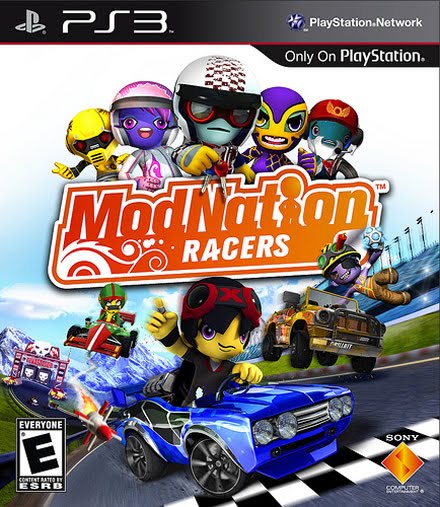
Review- ModNation Racers [PS3]

Publisher: Sony Computer Entertainment
Developer: United Front Games
Released: 21st May 2010

The ethos behind the 'Play, Create, Share' brand is excellent. Allowing users to easily design, edit and publish such content burgeons originality, creativity and provides a platform for brilliance. Following on from Media Molecule's platformer LittleBigPlanet, ModNation Racers puts the comparisons to Mario Kart behind it and delivers a unique and fresh approach towards the kart racer of old.

Dropped into ModNation's central hub world, 'Modspot', you'll begin to appreciate the beautiful, colourful and expertly presented output of the game. It's cute and charming, reflected further in its character design- of which can be crafted to your specific likening, with a stack-load of options to choose from, whilst being slightly over the top. Succinctly tailored for a younger and more casual-orientated audience than the likes of LittleBigPlanet, ModNation is at times alarmingly annoying for someone like myself to care for. Its news anchors Gary Reasons and Biff Treadwell doing little to alter my perception of the title, instead doing their best to be the most irritating characters ever devised, infusing the career “story mode” with cheap slapstick routines and a whole bout of childish humour. It's not the game's best hand, but then, it's not supposed to be. Perhaps someone ought to have passed the message to the race design department about the game's accessibility, because whatever it fails to match in my expectation of presentation, it more than makes up for in its deceptively tricky career mode, which manages to escape the shackles of its cutesy exterior into a much more daunting and unforgiving experience. I hope you're ready to restart time and time again for a position in the top three, because this will test your skills to the limits.

The career mode, or 'MRC'- the “ModNation Racing Championship”, is split into five distinct 'series' of races, each of which ending in a 'series' race where you will need to finish 1st to progress to the next tier. The rest of the time, races can be completed if you finish anywhere in the top 3- although the three tiers of racing finishes (“Advance”, “Payoff” and “Bonus”) add further re playability in that they each require you to match specific goals to unlock extra items, whether it be extra clothes for your character or new bodywork for your kart. Such goals add another layer and complexity to what could have been a simple racing championship platform, perhaps requiring you to focus your attacks on a specific opponent or drifting a certain length of time- the variety is nice to see and deeply rewarding for the collectors amongst you.

Of course, presentation and structure can all be for nothing in a game such as this if the racing mechanics fail to match the expected quality. However, United Front Games can be applauded in outputting a simply excellent racing system- easy to pick up and play yet complex enough to appeal to the more discerning palette. The handling feels exceptionally tight and responsive, whilst the game's emphasis on the drift mechanic can be appreciated since it works so well. Activated by holding the 'X' button, drifts can be executed easily, with more boost awarded for longer drifts, where the loosening and tightening of the drift angle using the left stick, is much needed.

The weapon and power-up system is also well thought out and surprisingly deep. In addition to a shunt-like attack, enabled through a flick of the right stick, each weapon type (the expected rockets, electric bolts, speed bursts etc.) each have three distinct stages of attack. Stage one for the bolt attack, for example, is a simple straight electric bolt fired from the front of the kart. However, holding off from firing and choosing to wait until you next drive over a weapons drop will see a much more effective attack to be used (“Chain Bolts”) and so forth, until the third and final attack can be unleashed, the “Bolt Storm”. It's a neat little idea, giving apt opportunity for diverse tactical play- choosing to fire straight away can be effective in the short-term but will have a lessened impact whilst choosing to wait can reap huge benefits, although you'll have to be sure not to be hit by an opponent's attack in the same breath- you may see your item disappear or, instead, drop down an attack level.
Another pleasant design choice is the option to use the boost meter (that fills through drifts, successful attacks on enemies, tricks, and air-time) as both a method to earn a boost through a hold of 'L1' or instead, as a gauge for activating the shield (holding 'Circle'). There's none more satisfying a feeling in the game than when rolling to victory when a last-ditch rocket is fired your way, only for you to deflect with the last ounce of boost bar saved for just that eventuality- others who are more offensive and go for short-term speed increase will not have such a luxury afforded to them. Again, it adds a nice risk/reward strategy and succeeds where other games of the type, such as Mario Kart and Crash Team Racing, fail- often relying more on doses of luck than any keen strategic thinking, not that ModNation ever truly breaks this trend!

At times more than keen on irking excessive amounts of frustration, the game often seems bizarrely unfair in delivering its heightening difficulty curve. Opponents often seem to have unlimited amounts of shield power still stocked away somewhere, shaking off any attack you are willing to let go, or unleash an explosive attack you're sure they didn't have as you approach the finishing line. The genre speciality of “rubber-banding” is also there, although it is much less intrusive than I have seen before.

With each track offering unique differences thematically and stylistically, ModNation's variety of track design is excellent. The nuance that comes with the game's territory seeing such locations filled with an abundance of obstacles to overcome (pits, falling blocks, explosive barrels), enemy bots to avoid, as well as exhilarating jumps and speed pads promising thrilling races and fun aplenty. Ranging from frenetically fast levels such as “Drift Paradise”, which uses its smooth curvaceous asphalt to inject fluidity, speed and lots and lots of tyre smoke, to trickier and tighter tracks such as the tropical island paradise of “Rickety Bridge” and its devilish drops. The description of the excellent “Launchers Rush” perhaps summing up ModNation Racers in the best possible way, promising “big jumps, big drifts and big flames”. The only down-side to the feel of the tracks is the fact that all have the same track width, which can not be changed. It's a strange choice in how obscure and diverse the rest of the game often feels. I'd have loved to have seen broad expanses of tracks inter-cut with single-file type canyons or something of the sort. It makes the pace sometimes feel slightly slow and sluggish- kart racers' tendency to sometimes dismiss the sense of speed shown once again here!

If none of the featured tracks take your fancy, however, you can always create your own or download other users' efforts. The central 'ModSpot' hub does its best to promote the very best created and rated tracks, mods, and karts (in the “Top Tracks”, “Top Mods” and “Top Karts” stations, respectively) that can be driven up to and displayed sufficiently well. It's one area where the game super-cedes LittleBigPlanet in its community aspect- which often struggled to promote the cream of the crop, as it were. You can also choose to search with text, by user, tags, or specific qualities to find the right thing for you.

From the lazy output of some user tracks that suffer from the same trophy-gathering hunt as a lot of the LBP levels also suffered from (“100,000 Drift Points” tracks, for example) to the incredible and ambitious designs of such tracks as the “Modcoaster” (rickety and all), and a Star Wars “Tatooine” effort. Such classics from a certain other successful kart racer are also present and accounted for, “Waluigi Stadium”, “Yoshi Circuit”, “DK Mountain”- naming but a few. The exquisite mods that re-create a number of the Mario Kart crew also complement such tracks, with the Mario and Luigi designs going quickly to the top of the mod pile on day one! The same exceptional quality in user content, like LBP, propels the game to something more than the standard title. It means that the game will be totally different in the years to come as even more tracks flood in, and although the same level of complexity can not be seen within the track creator as Sackboy's 'Pop It' tool, it doesn't need to be, there is something to be had for the insane amount of brilliant tracks that are already available to race on. Requiring the creator to first select a theme (from “Desert”, to “Jungle”), the track creator is manageable and simple to navigate. Upon insignificant alterations of the position of the sun, water level and even the speed of clouds, the track can easily be layed through driving the cement-mixer, altering height with the right thumb stick. The creator will also 'auto-complete' the rest of the track if you decide you just want to get on with populating it with an insurmountable array of power-ups, weaponry and jumps. Landscaping objects and trees can also add to the overall theme of your level, with tracks quickly coming up to an impressive level of sophistication without you realising! A joy to withhold for those who found LBP's creation tools much too overbearing, a nice track can be created in around 15 minutes!

Overall a resounding success and a superb addition to the kart racer genre. The level of complexity afforded with the help of neat tactical racing and superb handling physics is a joy to see, with only those who successfully rely on all their acquired skills ending up completing the career mode. Online multiplayer (featuring a levelling up, experience-based system) and split screen for up to four players is also available and will make ModNation substantial in offering a great alternative to the Mario Kart-ers of you out there.


Tuesday, 1 June 2010

Review- Bayonetta [PS3]


Publisher: Sega
Developer: Platinum Games
Released: 8th January 2010
Other Formats: Xbox 360

There are few games that boast such over-the-top action and outlandish characters than Bayonetta, an action brawler with a sexed up, shape-shifting witch as protagonist that kills with her hair- right then... From its opening moments of awe-inspiring action, the pace simply never lets up. This is a game with set piece after glorious, gruesome set piece, and enough boss iteration and flair to sink some of the best that the combo-action brawler genre has to deliver.

The vivid, colourful art style and natural beauty that irradiates from every nuance of its design lend a suitable platform to the visuals- a deft mix of motion blurred colour swipes and beautiful back-drops with more visual flourishes than a Zack Snyder movie. From the stark purple hue that overlays the screen as the “bullet time” mechanic is introduced (a result of a last-minute dodge that reduces time to a stand-still, giving apt time for combo glory!) to the ferocious, kinetic cinematics present within its cut scenes. The comic book aesthetic, with the use of still film cells, helping to further propel its narrative and character interaction- amongst which, love interest “Luka”, rival “Jeanne”, and distinct arch-enemy “Balder”, all adding gravitas to the somewhat confusing and largely ignorable story. The music also does its utmost best to match the gorgeous visuals- a blend of arcade-inspired musical twangs and synth-pop backing tracks laying foundations to the brutal, yet sassy action on display.

The team at Platinum Games can be applauded in crafting a dynamic assault on the 3D action brawler of old, delivering enough variety to keep the pace of the game consistent within its 10-hour or so play through. The suitably stunning and epic boss battles (each of which are memorable and differentiated from each other to keep things feeling fresh and exciting and finished in the suitably titled “Climax” QTE), have been dealt in accordance in bringing a grandiose template to the experience that could otherwise have felt disparagingly alike to others within the crowded genre. Sublime in both scale and design, Bayonetta's bountiful grace juxtaposes the vicious bestial creatures at her behest perfectly. The Devil May Cry- like combo action that forms the might of the game is some of the most fluid and intense I have ever played, with Bayonetta's agility ensuring game play feels smooth, frantic and undeniably fun whilst also providing enough complexity for the most hardcore of gamers to enjoy. The many different combos, mixing ranged (from Bayonetta's choice of angelic-slaughtering guns) to close-quarters melee, each complex in their own right, requiring players to hold buttons for longer amounts of time in different combo nuances. The action is also rich in variety, in the addition of the short animated trinkets of “brutal moves” that deliver a devilish blow to enemy forces. The ability to test your mettle in the over-long loading screens, (in which button presses relay into a presenting of a specified combo), means such extended lulls from the main game are a suitable proving ground in refining technique or learning new attacks and is a brilliant addition, showing the developer is more than willing to put in that little extra effort for a slight digression from what could have been the usual 'Did you Know?' screens we've all seen time and time again. It's a promise also shown in the game's variety of design- the changing environments, from the urban city of Vigrid, to the volcanic catacombs that infuse the religious imagery at the center of the game and the combo action infused with puzzles and explosive vehicular sections, ensuring the pace never lets its foot of the accelerator- only helped by the smooth curve of new abilities provided, and in-game combat choices available (a variety of weapons unlocked with collectible, golden LP's).

In what feels at times like an arcade game, only helped along by its musical influences and multiplier, score-based design (awards are given on the completion of each “verse” within each chapter, ranging from stone to the highs of “pure platinum”), Bayonetta boasts sex, style and an abundance in opportunities to show off (delivered in Bayonetta's seductive poses to camera). The breathtaking set piece sequences are also some of the best that the genre has to offer players. It's a shame then, that the ability to control the camera is slow and sluggish, and at times frustrating in controlling the action. The story is also distinctly poor and underwhelming, led along by brilliant personalities and stylish action, nonetheless. It's a game I can't help but recommend for all the right reasons- a combat system that is refined and effective, explosive action, and an intriguing and fresh angle to the post of protagonist, worthy of its plaudits that was greeted upon its arrival.